


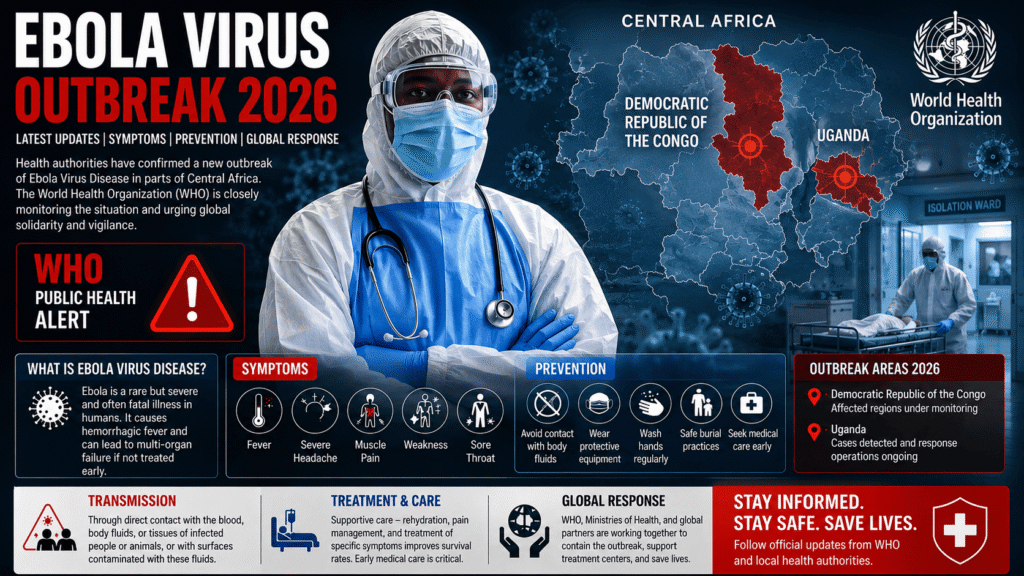
A virus outbreak can feel distant until it suddenly isn’t. In May 2026, Ebola is back in the global spotlight after the World Health Organization declared the outbreak in the Democratic Republic of the Congo and Uganda a public health emergency of international concern, with more than 300 suspected cases and 88 deaths reported in recent updates. For readers searching ebola virus, ebola outbreak 2026, or ebola news, the priority is simple: understand what Ebola is, how it spreads, what symptoms to watch for, and what health authorities are recommending right now.
Table of Contents
What Is Ebola Virus?
Ebola virus disease, also called Ebola disease or Ebola virus disease, is a severe viral illness that can cause hemorrhagic fever and is often fatal without rapid supportive care. The current 2026 outbreak has been linked to the Bundibugyo virus, a rare Ebola species, and WHO has said there is no licensed vaccine or specific therapeutic for this strain. That makes the present situation especially important for Africa’s health emergency response and broader pandemic preparedness planning.
Symptoms Of Ebola Virus Disease
Ebola symptoms usually begin 2 to 21 days after exposure, and a person cannot spread the virus until symptoms start. Early illness often looks like a severe flu, which is one reason the disease can be missed at first.
Common early symptoms
- Fever.
- Fatigue and weakness.
- Muscle pain.
- Headache.
- Sore throat.
Later symptoms
- Vomiting.
- Diarrhea.
- Abdominal pain.
- Rash.
- Bleeding from the gums, blood in stool, or other internal and external bleeding in some cases.
If someone has these symptoms and lives in or recently traveled from an affected area, they need urgent medical evaluation.
Causes And Transmission
So, how does Ebola spread? Ebola spreads through direct contact with the body fluids of an infected person, especially blood, vomit, feces, urine, saliva, sweat, semen, and breast milk, or through contaminated objects such as bedding, clothing, needles, and medical equipment. It is not spread through the air, and WHO says people are infected through close and direct physical contact, not casual breathing in a room.
The virus can also jump from animals to humans through contact with infected wildlife or raw meat from bats and nonhuman primates. After that first spillover event, person-to-person transmission becomes the major concern, especially in households, hospitals, and burial settings where infection control is weak.
Ebola Outbreak 2026 Latest Updates
The ebola outbreak latest updates in mid-May 2026 show a serious cross-border emergency in Central Africa. WHO declared the outbreak in the DRC and Uganda a public health emergency of international concern after reporting more than 300 suspected cases and 88 deaths, while the Africa CDC reported 336 suspected cases and 87 deaths in the DRC alone in one update.
Health officials said most suspected cases are in eastern DRC, especially Ituri province, with additional concern about spread to Kinshasa and neighboring Uganda. The outbreak is being closely watched because the Bundibugyo strain has no licensed vaccine or specific treatment at this time.
What WHO is saying
WHO has urged countries not to close borders in panic, but instead to strengthen surveillance, contact tracing, laboratory testing, infection prevention, and community engagement. It has also advised health systems to activate emergency mechanisms quickly and scale up treatment capacity where needed.
Which Countries Are Affected?
As of the latest reports, the main affected country is the Democratic Republic of the Congo, with cases and suspected deaths concentrated in Ituri province. Uganda has also reported imported cases linked to travel from the DRC, including a death in Kampala and another confirmed case in the capital.
This is why the current ebola outbreak 2026 matters beyond national borders. When an infectious disease crosses into a neighboring country, health authorities must move fast to prevent a larger regional virus outbreak.
Prevention And Safety Measures
The best ebola prevention strategy is strict infection control, early detection, and avoiding direct contact with blood or body fluids from sick people. Community awareness matters too, because fast recognition can save lives and stop chains of spread.
Practical safety steps
- Wash hands often with soap and water.
- Avoid contact with sick people or the bodies of people who have died from Ebola.
- Do not handle contaminated clothes, bedding, needles, or medical items.
- Avoid raw meat from bats and nonhuman primates.
- Seek immediate medical care if symptoms appear after possible exposure.
Health workers should use full personal protective equipment and follow strict isolation and disinfection protocols. People who may have been exposed are generally monitored for 21 days, which matches the incubation window for Ebola symptoms.
Treatment And Vaccines
For the current Bundibugyo-related outbreak, WHO says there is no licensed vaccine or specific therapeutic available. That makes supportive care the cornerstone of ebola treatment, including rehydration, symptom management, and intensive clinical monitoring.
For some other Ebola strains, there are better tools available. WHO noted in 2025 that candidate vaccines and treatments were being used in Uganda for Sudan virus disease through clinical trial protocols, and CDC says Ervebo is an approved vaccine for Ebola virus species prevention in certain contexts. Even so, outbreak response still depends heavily on rapid isolation, tracing, safe burials, and excellent hospital infection control.
WHO Guidelines And Health Alerts
WHO’s current message is balanced but serious: this outbreak is dangerous, but panic and travel bans are not the solution. Instead, health authorities are emphasizing accurate public information, contact tracing, surveillance, and treatment readiness.
WHO also says the outbreak does not meet the criteria for a pandemic emergency like COVID-19, even though it is classified as a public health emergency of international concern. That distinction matters because the response for Ebola relies on targeted containment rather than broad population-level restrictions.
Why This Outbreak Matters
This 2026 outbreak is a reminder that deadly virus outbreak 2026 headlines are not just statistics; they are signals that health systems must stay prepared. Ebola remains one of the world’s most feared infectious diseases because it can spread quickly in close-contact settings and can be devastating when diagnosis or isolation is delayed.
The good news is that the world knows far more about Ebola now than it did in earlier outbreaks. Faster lab testing, stronger surveillance, and stronger hospital infection prevention can make a major difference.
Conclusion
The latest ebola virus situation in 2026 is serious, but it is also a test of global preparedness, transparent reporting, and rapid public health action. For readers following ebola outbreak latest updates, the most important takeaway is to rely on WHO and trusted health sources, watch for symptoms after exposure, and follow prevention advice immediately.
Share this article to help others stay informed, and keep following verified health alerts so the next update is understood early, not after the damage is done.
FAQ
What is Ebola virus?
Ebola virus disease is a severe viral illness that can cause fever, vomiting, diarrhea, bleeding, and organ failure in some cases.
How does Ebola spread?
It spreads through direct contact with infected body fluids, contaminated objects, or infected animals, not through the air.
What are the first Ebola symptoms?
The first symptoms are usually fever, weakness, headache, muscle pain, and sore throat.
Is there a cure for Ebola?
There is no guaranteed cure, and for the current Bundibugyo outbreak WHO says there is no licensed vaccine or specific treatment; care is mainly supportive.
Which countries are affected in 2026?
Current updates point mainly to the DRC, with imported cases reported in Uganda.
Can Ebola be prevented?
Yes, by avoiding exposure to body fluids, using PPE in healthcare settings, and isolating suspected cases quickly.